
Imagine stepping into a virtual boardroom, facing a challenging team dynamic, and practicing your leadership skills — all from your living room. This is no longer science fiction; it’s the new frontier of coaching.
I have witnessed firsthand how virtual reality (VR) and augmented reality (AR) can unlock new dimensions of growth for clients. My approach blends evidence-based practice with a commitment to ethical innovation, ensuring that every client’s journey is both transformative and responsible. These technologies are not just theoretical — they’re actively reshaping how we coach.
As technology rapidly transforms how we learn and grow, VR and AR are emerging as powerful tools for coaches and clients alike. Since their origins in 1968 with the first head-mounted display for virtual reality and in 1992 with the introduction of augmented reality for industrial applications, these technologies have evolved from experimental novelties to practical assets in professional development (Sutherland, 1968; Caudell & Mizell, 1992). Today, they offer immersive, interactive experiences that drive skill development and personal growth — perfectly aligning with ICF Core Competency 8: Facilitates Client Growth. This article explores how VR and AR are reshaping coaching, their current applications, future potential, and the ethical considerations every coach should know.
The Power of VR and AR in Coaching: Real Stories, Real Impact
VR immerses clients in realistic simulations — such as leadership scenarios — where they can practice decision-making and problem-solving without real-world risks. For example, I recently worked with a client — a mid-level manager — who struggled with public speaking anxiety. Through a VR simulation of a conference room, he practiced delivering presentations to a virtual audience. Over several sessions, his confidence grew, and he reported feeling more prepared and less anxious in real meetings. This immersive, risk-free environment accelerated his progress in ways traditional coaching could not.
AR, on the other hand, overlays real-time feedback, such as live guidance on body language during a presentation, enabling immediate skill refinement. Research on immersive learning environments shows moderate-to-large effect sizes (≈0.5 to 0.8) for engagement and training outcomes, which corresponds to roughly a 64% to 71% advantage over traditional training conditions, demonstrating how experiential learning through VR and AR can substantially increase learner engagement and skill development (Kaplan et al., 2021).
These technologies support ICF’s Core Competencies, particularly Embodies a Coaching Mindset, including the use of technology in coaching and best practices, as well as Facilitates Client Growth by integrating new awareness into behaviors. VR provides safe, repeatable practice spaces where clients experiment and build confidence, while AR’s real-time feedback accelerates skill refinement. Together, they offer a transformative approach that blends immersion with actionable insights.
Current Uses of VR and AR in Coaching Practice
VR and AR are already reshaping coaching. In pre-service teacher training, immersive classroom simulations have been shown to significantly strengthen instructional confidence and decision-making capability, with studies reporting dramatic improvements in teacher self-efficacy and classroom leadership readiness — often approaching gains of up to 70% in confidence measures (Dalinger et al., 2020; Gundel et al., 2019; Theelen et al., 2019). Coaches can use VR to simulate complex scenarios, such as navigating team conflict or practicing difficult conversations, allowing clients to experiment with responses in a controlled environment. AR complements this by providing real-time contextual feedback during task performance, a capability demonstrated in immersive training systems that guide users through complex activities and reinforce learning through immediate cues and corrective prompts (Ariansyah et al., 2024).
Getting Started:
- Explore affordable VR platforms designed for coaching or education — many now offer coaching-specific scenarios for leadership development, public speaking, and team dynamics.
- Start with simple AR apps that provide real-time feedback on communication skills, such as those tracking vocal patterns, pace, and body language during presentations or meetings.
- Connect with other coaches experimenting with these tools via ICF forums, local chapters, or LinkedIn groups focused on technology in coaching.
Unlike traditional group workshops or peer-observed practice sessions, VR and AR offer private, controlled environments for personalized growth.
The Future of Coaching With VR and AR: What’s Next?
Over the next five years, virtual coaching environments and AI-driven AR feedback systems are expected to expand rapidly as immersive technologies become integrated into professional training and development platforms (PwC, 2022). Imagine clients joining VR sessions from anywhere, immersing themselves in tailored scenarios, while AI-enhanced AR delivers personalized feedback. This blend of virtual and in-person coaching will democratize access, break geographical barriers, and expand high-quality coaching to diverse audiences.
By integrating these technologies, coaches can combine the personal touch of traditional coaching with innovative, immersive experiences, enhancing client outcomes. While the benefits are clear, it’s equally important to consider the ethical and practical challenges these technologies present.
Navigating Ethical Challenges: Inclusion, Privacy, and Practical Tips
VR and AR also have the potential to bridge gaps for clients with disabilities or those in remote locations, offering customizable environments that accommodate different learning styles and accessibility needs. By leveraging these technologies, coaches can foster greater inclusion and ensure that high-quality coaching is available to a broader, more diverse audience.
However, these advances come with ethical considerations. Biometric data collection (for example, eye movements or voice patterns) raises privacy concerns, as immersive devices increasingly collect behavioral and biometric signals capable of revealing sensitive personal information (Bozkir, 2025; Miller et al., 2020), requiring coaches to prioritize informed consent and secure data handling.
Tip: Always inform clients about what data is collected and use platforms that comply with privacy standards.
Accessibility remains a challenge, with VR headsets ranging from about $299 for consumer devices to $3,499 and up for advanced mixed-reality systems, potentially limiting access. Coaches must advocate for affordable solutions and reliable infrastructure to ensure equitable access and address digital divides (Meta, 2024; Apple, 2024; Ward et al., 2025). On the positive side, VR and AR can substantially reduce resource use and training costs, often by 30% to 50% or more, as digital simulations replace physical laboratories, equipment, and travel-intensive training environments (Javaid et al., 2024; PwC, 2020).
Join the Conversation on VR and AR in Coaching
How might VR and AR transform your coaching practice or your clients’ growth? I invite you to share your stories, questions, and insights at ICF Engage, and to help shape the future of coaching as we look ahead to Converge 2026. Let’s explore together how technology can make coaching more accessible, impactful, and inclusive for all.
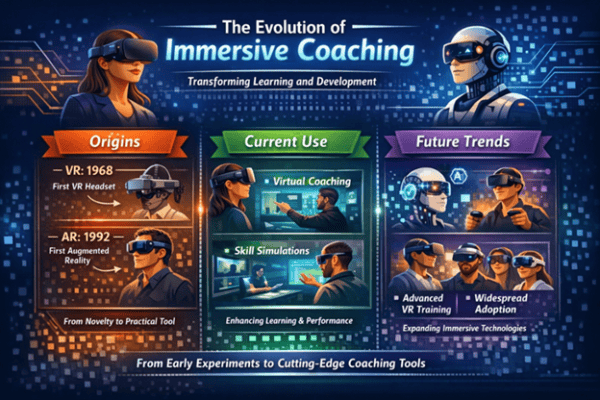
The content is the author’s original work. AI was used solely to generate the image.
Disclaimer
The views and opinions expressed in guest posts featured on this blog are those of the author and do not necessarily reflect the opinions and views of the International Coach Federation (ICF). The publication of a guest post on the ICF Blog does not equate to an ICF endorsement or guarantee of the products or services provided by the author.
Additionally, for the purpose of full disclosure and as a disclaimer of liability, this content was possibly generated using the assistance of an AI program. Its contents, either in whole or in part, have been reviewed and revised by a human. Nevertheless, the reader/user is responsible for verifying the information presented and should not rely upon this article or post as providing any specific professional advice or counsel. Its contents are provided “as is,” and ICF makes no representations or warranties as to its accuracy or completeness and to the fullest extent permitted by applicable law specifically disclaims any and all liability for any damages or injuries resulting from use of or reliance thereupon.

Related Posts

How Coaches Use AI Tools to Make Insights Visible
AI tools can help coaches uncover patterns, organize complex information, and present insights in ways clients can understand and act on. Discover how coaches are using AI to enhance reflection and decision-making while preserving the essential human connection.

Coaching Across Cultures: Why Cultural Intelligence Will Shape the Profession’s Global Future
Cultural intelligence in coaching is the ability to work effectively across cultures with curiosity, adaptability, and ethical awareness. As coaching expands globally, strong practice will depend on more than translation. It will depend on local relevance, inclusive design, and a willingness to let more voices shape the profession.

The Artisan’s Advantage: What AI Can’t Take From You
Coaches face a threat they haven’t noticed: not being replaced by AI, but being bypassed. Learn what makes your approach irreplaceable.